

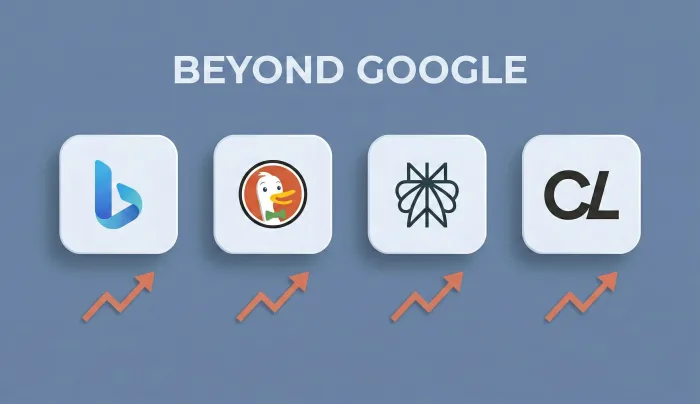
Here's a number that should change how you think about search: Google's share of the search market dropped from 93% to 89.7% in 2025, according to StatCounter. That's the fastest decline in Google's history. Where did those users go? Bing, DuckDuckGo, Perplexity, Claude, and Gemini.
You might think: 10% is nothing. But 10% of 8.5 billion daily searches is 850 million searches per day happening outside Google. That's more than the entire search market of 2005. And these aren't random users — they're often higher-value: privacy-conscious professionals on DuckDuckGo, power users on Perplexity, enterprise workers using Bing through Microsoft 365, and early adopters asking Claude for recommendations.
Most businesses optimise exclusively for Google. Which means on every other platform, competition is dramatically lower. The same keyword that costs you €8/click on Google Ads might have zero competition on Bing. The same question that returns 10 competitors on Google might return only 2 on Perplexity — and you could be one of them.
Bing: The Search Engine You're Ignoring (and Shouldn't Be)
Bing powers more searches than most people realise. It's the default search engine for Microsoft Edge (which has 680 million users), Windows Search, Xbox, and Cortana. It feeds results to Yahoo, DuckDuckGo (partially), and dozens of smaller search engines. And since Microsoft integrated AI into Bing via Copilot, its usage has grown 15% year-over-year.
But here's what makes Bing different from Google — and why it matters for your strategy:
- Bing prioritises exact-match keywords more than Google. While Google has moved heavily toward semantic search, Bing still rewards pages that contain the exact phrases people search for. Put your target keywords in your title tag, H1, and first paragraph.
- Bing values social signals. Unlike Google (which claims social signals aren't a ranking factor), Bing openly uses social engagement as a ranking signal. Active Facebook, LinkedIn, and Twitter profiles with shares and engagement directly boost your Bing rankings.
- Bing rewards multimedia content. Bing gives more ranking weight to pages with images, video, and interactive elements than text-only pages.
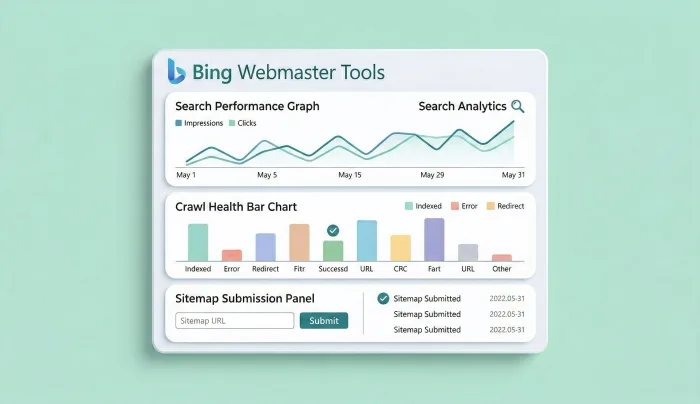
- Bing Webmaster Tools is underrated. Submit your sitemap, review crawl errors, and check your search performance. Most competitors haven't done this, which means you'll be ahead just by showing up.
How to Optimise for Bing (Quick Wins)
1. Submit your site to Bing Webmaster Tools — takes 5 minutes, most competitors haven't done it
2. Use exact-match keywords in title tags, meta descriptions, and H1 headings
3. Add Open Graph and meta tags — Bing uses them more than Google does
4. Embed video and images on your key pages — Bing rewards rich media
5. Keep your social profiles active — Bing checks Facebook, LinkedIn, and Twitter engagement
6. Use clear, hierarchical site structure — Bing's crawler is less sophisticated than Google's, so make your architecture explicit with breadcrumbs and internal links
DuckDuckGo: Privacy-First Search with Premium Users
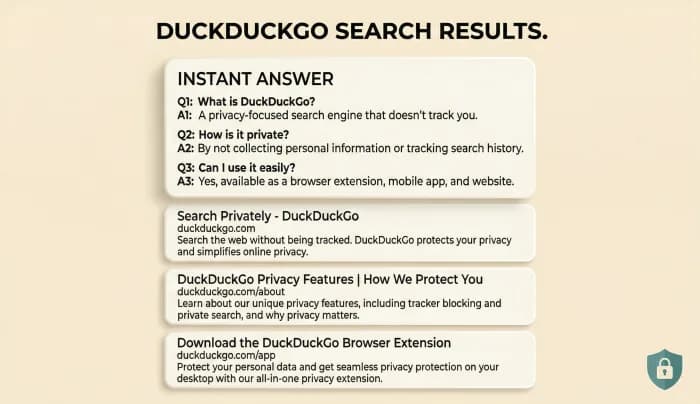
DuckDuckGo handles over 100 million searches per day and has grown 50% since 2022. Its users choose it specifically because they value privacy — and that demographic skews toward tech-savvy professionals, higher income brackets, and B2B decision-makers.
DuckDuckGo doesn't have its own index for most results. It pulls from Bing, its own crawler (DuckDuckBot), and over 400 source websites including Wikipedia, Apple Maps, and Yelp. This means:
- If you rank on Bing, you likely rank on DuckDuckGo. Optimising for Bing gives you DuckDuckGo almost for free.
- DuckDuckGo favours HTTPS and fast-loading sites. Since privacy is their brand, they penalise sites with tracking scripts and slow load times more aggressively.
- Local results come from Apple Maps, not Google Maps. Make sure your Apple Business Connect listing is claimed and accurate.
- DuckDuckGo's Instant Answers pull from structured sources. If your site has clean schema markup (FAQ, HowTo, Organization), DuckDuckGo may feature your content directly at the top of results.
The DuckDuckGo audience is small but valuable. A B2B service provider told us their DuckDuckGo traffic converts at 3x the rate of their Google traffic — because the audience is more technical and intentional.
How to Optimise for DuckDuckGo
1. Optimise for Bing first — DuckDuckGo pulls most results from Bing's index
2. Claim your Apple Business Connect listing — this feeds DuckDuckGo's local results
3. Remove unnecessary tracking scripts — DuckDuckGo downranks tracker-heavy sites
4. Implement schema markup (FAQ, HowTo, Organization, LocalBusiness) — powers Instant Answers
5. Get listed on Wikipedia, Wikidata, or niche directories — DuckDuckGo pulls from these for featured content
6. Ensure HTTPS everywhere — non-HTTPS sites are penalised harder on DDG than on Google
Perplexity: The AI Search Engine That Cites Sources
Perplexity is the fastest-growing search alternative, with over 15 million monthly active users and $500M+ in funding. Unlike ChatGPT, Perplexity searches the web in real-time and cites its sources. This changes everything.
When someone asks Perplexity a question, it:
1. Searches the web for relevant pages
2. Reads and synthesises the content
3. Generates a summarised answer
4. Lists the source URLs it used
This means getting cited by Perplexity sends real traffic to your website — unlike ChatGPT, which usually doesn't link back. And because Perplexity's audience skews toward researchers, professionals, and B2B buyers, that traffic tends to be high-quality.
What determines if Perplexity cites your content:
- Depth and specificity: Perplexity prefers detailed, expert-level content over thin overview pages
- Freshness: Recent content is heavily weighted — a 2026 article beats a 2023 article on the same topic
- Direct answers: Content structured with clear headings and concise answers to specific questions performs best
- Authoritative tone: First-person expertise ("In our experience...", "We tested this and found...") signals originality over regurgitated content
- Schema markup: PerplexityBot can read structured data, making your content easier to parse and cite
How to Get Cited by Perplexity
1. Write content that directly answers specific questions — not vague overviews, but "How much does X cost in 2026?" with real numbers
2. Include original data, case studies, or first-person experience — Perplexity prioritises original sources over content farms
3. Update content regularly — add a "Last updated: [date]" and refresh stats/examples quarterly
4. Use descriptive H2/H3 headings that match search queries — "How much does a WhatsApp bot cost?" as a heading, not "Pricing considerations"
5. Don't block PerplexityBot in robots.txt — check your robots.txt right now (Kaufast's own robots.txt explicitly allows PerplexityBot)
6. Publish on your own domain — Perplexity credits the source URL, so content on your site (not Medium or LinkedIn) drives traffic back to you
Claude: The AI That Reads Your Entire Website
Claude (by Anthropic) is different from both Google and Perplexity. People don't use Claude to "search" — they use it to research, analyse, and get recommendations. A business owner might paste your entire website into Claude and ask: "Is this company legit? Should I hire them?"
Claude can process up to 200,000 tokens in a single conversation — that's roughly 150,000 words. Users upload PDFs, paste URLs, and have in-depth conversations about whether your business is worth their money.
What this means for your optimisation:
- Your entire website is your pitch. Claude users don't just see your homepage — they evaluate everything. Contradictions between your About page and your service descriptions get noticed.
- Consistency is critical. If your homepage says "AI solutions" but your blog posts are all about generic SEO tips from 2022, Claude will flag the inconsistency when asked about your expertise.
- Case studies and proof matter enormously. When someone asks Claude "Should I hire [Your Company]?", it looks for evidence: real project descriptions, specific results, named clients, verifiable claims.
- Structured content helps Claude parse your offerings. Clear service pages with defined deliverables, timelines, and pricing ranges make it easy for Claude to summarise your business accurately.
How to Optimise for Claude
1. Audit your website for consistency — does every page tell the same story about who you are and what you do?
2. Add detailed case studies with specific numbers ("Reduced response time by 73%" not "improved efficiency")
3. Make your services page explicit — list what you deliver, how long it takes, and a price range
4. Keep your About page honest and specific — real founder story, real team, real location
5. Create an llms.txt file (we have one at kaufast.com/llms.txt) — this tells AI systems what your business is about in a machine-readable format
6. Remove contradictions — if you pivoted from SEO to AI, update EVERY page, not just the homepage
The Cross-Platform Strategy (What Actually Works)
Here's the good news: you don't need four separate strategies. About 80% of the work overlaps. Here's the unified approach:
Foundation (helps everywhere):
- Clean, fast website with HTTPS
- Complete schema markup (Organization, LocalBusiness, FAQ, Service, HowTo)
- Consistent entity identity across the web
- Fresh, detailed, expert content updated regularly
Bing + DuckDuckGo specific:
- Submit to Bing Webmaster Tools
- Claim Apple Business Connect listing
- Keep social profiles active with engagement
- Use exact-match keywords in titles and H1s
Perplexity + Claude specific:
- Write content that answers specific questions with data
- Include original research, case studies, and first-person expertise
- Create an llms.txt file
- Don't block AI crawlers (PerplexityBot, ClaudeBot, GPTBot, CCBot)
Time investment: If your Google SEO foundation is solid, adding Bing/DuckDuckGo/Perplexity/Claude optimisation takes about 4-6 additional hours of work. The ROI is disproportionate because competition on these platforms is still minimal.
What We're Seeing in Practice
Across our client projects, businesses that optimise beyond Google typically see:
- 15-25% increase in total organic traffic within 3 months (Bing and DuckDuckGo combined)
- Perplexity citations appearing within 4-8 weeks for updated content
- Higher conversion rates from non-Google traffic (DuckDuckGo users convert 2-3x better)
- Better AI recommendations when users ask Claude or ChatGPT about the business
The window is now. Most competitors haven't even submitted their site to Bing Webmaster Tools. Every day you wait, someone else in your industry is quietly claiming that space.
Start with Step 1: Submit your site to Bing Webmaster Tools. It takes 5 minutes and immediately gives you access to a platform that feeds results to Bing, DuckDuckGo, Yahoo, and Microsoft Copilot. Then work through the platform-specific steps above.
Need help building a cross-platform search strategy? We optimise businesses for Google, Bing, Perplexity, and AI assistants — because ranking on one search engine isn't enough anymore.