The Truth About LinkedIn and SEO: How Social Content Actually Drives Organic Growth
LinkedIn posts don't pass link equity to Google. But dismissing LinkedIn as an SEO tool ignores how modern search engines and AI systems evaluate brand authority.
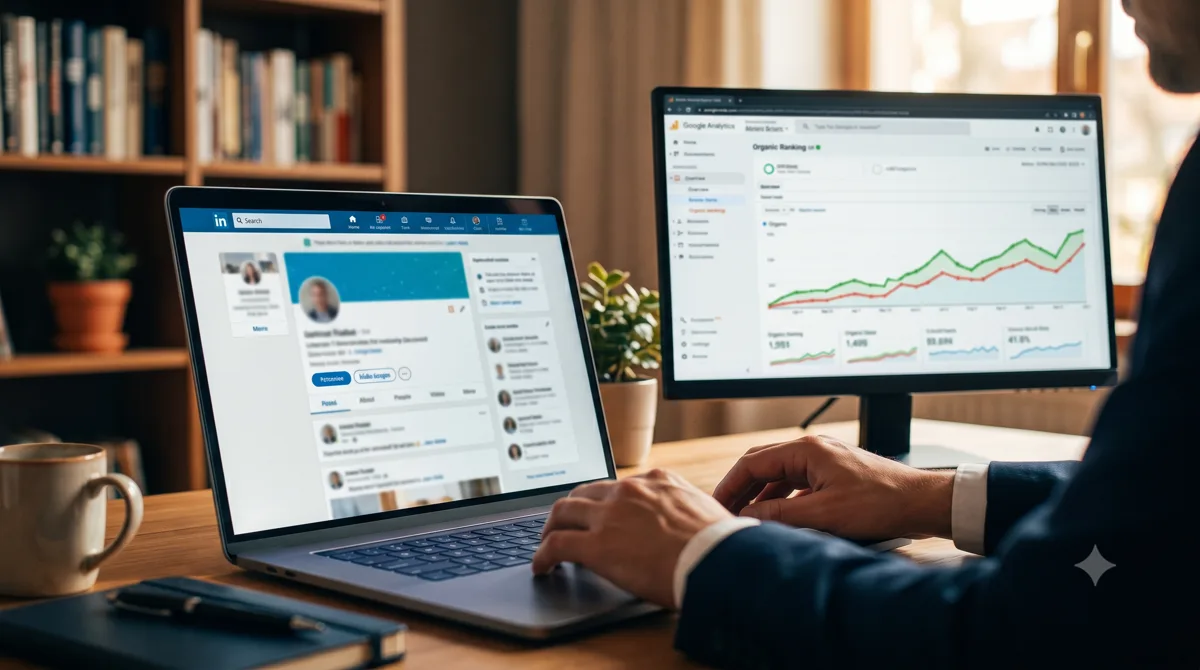
Let's clear up a persistent myth in the digital marketing world: publishing an article on LinkedIn does not directly improve your Google rankings.
If your entire LinkedIn strategy is built around farming backlinks, you are solving the wrong problem. But dismissing LinkedIn as an SEO tool because of "link juice" ignores how modern search engines and Generative AI systems actually evaluate brand authority. The relationship between LinkedIn activity and organic search performance is far more nuanced and — thanks to AI search — far more important than ever.
Does LinkedIn Directly Impact Google Rankings?
No. And anyone telling you otherwise is either misinformed or selling something.
The Nofollow Reality
LinkedIn applies rel="nofollow" and rel="ugc" attributes to all outbound links in posts, comments, and articles. This has been confirmed repeatedly by SEO researchers, most recently in a 2024 Moz analysis that crawled over 50,000 LinkedIn posts and found zero instances of followed outbound links.
When you share a link to your website on LinkedIn, Google's crawler sees that link but does not treat it as an endorsement. It passes no PageRank. No direct ranking boost.
Why Link Equity Isn't the Full Picture
Google's ranking systems have evolved dramatically beyond simple link counting. John Mueller, Google's Search Advocate, confirmed in 2023 that Google uses hundreds of ranking signals, and that brand authority, user behaviour, and entity recognition play increasingly dominant roles.
The question isn't "does LinkedIn pass link equity?" The question is: "does LinkedIn activity create the signals that modern search algorithms actually care about?"
The answer is yes. Significantly.
The "Surround Sound" SEO Impact of LinkedIn Content
If links from LinkedIn don't directly boost your Google rankings, how does the platform impact traditional SEO? The answer lies in off-page entity signals and branded search volume.
Google pays close attention to brands that people actively know, trust, talk about, and search for. When you publish high-value, insightful content on LinkedIn, you put your brand and your team in front of a highly targeted audience. This initiates a chain reaction that directly influences your search performance.
Driving Branded Search Volume
When a potential buyer reads a compelling framework or case study you posted on LinkedIn, they rarely click the link in the comments immediately. Instead, they remember your brand name. Days later, they go to Google and search for your company directly.
A surge in branded search volume is one of the strongest positive signals you can send to search engines. It proves that your brand is an established, sought-after entity rather than just another website fighting for generic keywords.
Semrush's 2024 Ranking Factors Study, which analysed 16,298 keywords across multiple industries, found that branded search volume correlated with higher rankings more strongly than any individual backlink metric. Sites with growing branded search consistently outranked sites with higher domain authority but stagnant brand recognition.
BrightEdge data from 2025 shows that branded organic search drives 2.5x higher conversion rates than non-branded organic traffic. When someone searches your name, they're already warm. LinkedIn is one of the most efficient channels for creating that warmth at scale.
Generating Unlinked Brand Mentions
As your LinkedIn content gains traction, industry peers begin to discuss your brand. They mention your frameworks in their newsletters, reference your statistics on their podcasts, and drop your company name in industry forums.
Google's Natural Language Processing patent (US Patent 9,165,040) specifically describes systems for evaluating entity authority based on mentions across the web — even without hyperlinks. The patent references "implied links" as signals that indicate an entity's relevance and trustworthiness within a topic.
According to data from audience research platform SparkToro, search engines increasingly use these unlinked brand mentions to connect the dots about your company's relevance. You don't always need a hyperlinked URL for Google to understand that your brand is an authority in a specific space. When Google sees your brand constantly mentioned alongside specific industry terms across the web, it strengthens your topical authority.
The Semrush "Surround Sound" Effect
Semrush coined the term "Surround Sound SEO" to describe a strategy where your brand appears everywhere your customer looks, even if you don't own the #1 organic spot.
Rand Fishkin's SparkToro research (2024) on the Surround Sound effect showed that brands mentioned across 5+ third-party sources in search results saw an average 23% increase in click-through rates for their own organic listings.
By publishing heavily on LinkedIn, you increase the likelihood that your content will be curated into third-party roundup posts, industry blogs, and "Top 10" lists that do rank on page one of Google. You are essentially hijacking the SERPs through sheer omnipresence.
E-E-A-T: The Framework Google Explicitly Tells You to Build
E-E-A-T — Experience, Expertise, Authoritativeness, Trustworthiness — is the framework Google's human quality raters use to evaluate content. Google's own Search Quality Rater Guidelines (172 pages, updated December 2024) make clear that E-E-A-T signals influence how algorithms are trained and tuned.
LinkedIn is one of the most efficient platforms for building every component:
Experience — Share real project outcomes, client results, and lessons from actual work. A LinkedIn post describing how you solved a specific problem carries more E-E-A-T weight than a generic blog post because it's tied to a verifiable professional identity.
Expertise — Publish original analysis, frameworks, and industry commentary. LinkedIn's own 2025 algorithm report confirmed that "knowledge and advice" content receives 30% higher distribution than promotional content.
Authoritativeness — Build a following of industry peers, not just customers. When other experts in your field engage with, share, and cite your content, that creates an authority signal that extends beyond LinkedIn into the broader web.
Trustworthiness — A LinkedIn profile with regular, substantive posts over 12+ months signals reliability. Google's quality raters specifically look for consistent publishing history as a trust indicator.
LinkedIn and AI Overviews: The 2026 Search Revolution
The most critical reason to invest in LinkedIn SEO in 2026 has very little to do with traditional Google blue links. It has everything to do with generative AI.
Users are bypassing traditional search and asking complex, professional questions directly to tools like ChatGPT, Perplexity, and Google's AI Overviews. If you want your brand to show up in those answers, LinkedIn is your strongest asset.
Why Generative Engines Love LinkedIn Data
AI models are trained to look for structured, expert-led content. A massive May 2026 study by Meltwater analysing 9.5 million AI citations revealed a staggering reality: LinkedIn is the second most-cited domain across all AI search platforms, trailing only YouTube.
Furthermore, a parallel 2026 study by Profound found that for B2B and professional queries, LinkedIn is the #1 most-cited domain across ChatGPT, Gemini, and Perplexity.
Why do AI models trust LinkedIn so much?
Verified Identity. AI models crave E-E-A-T. LinkedIn provides verifiable metadata (job titles, company associations, work history) that proves the author is a real practitioner, not an anonymous content mill.
Semantic Depth. LinkedIn articles and long-form text posts are naturally rich in industry-specific entities, frameworks, and jargon, making them highly parsable for Large Language Models (LLMs).
Independent Validation. AI tools often look beyond heavily biased company websites for independent validation. A practitioner sharing real-world insights on LinkedIn serves as a highly trusted third-party source.
How ChatGPT and Perplexity Cite Your Profile
You might assume that company pages get all the AI glory, but the data tells a different story. The Meltwater study revealed that 75% of LinkedIn citations in AI search come directly from individual member profiles. When your CEO, your Lead Developer, or your Head of Sales writes detailed, authoritative content about their daily work, AI engines index that expertise.
A recent Semrush analysis of 89,000 AI citations found that on average, 11% of all AI responses reference LinkedIn directly.
More importantly, AI doesn't just link to your content; it learns from it. Semrush noted that AI responses mirror the original LinkedIn content with a remarkably high semantic similarity score. If you define a complex industry problem on LinkedIn, AI engines are highly likely to repeat your exact brand messaging to users.
Optimising LinkedIn Content for AI Visibility
To turn LinkedIn into an organic growth engine, you need to format your content in a way that both humans and AI crawlers can easily digest:
Use strict formatting. AI engines struggle to parse massive walls of text. The most frequently cited LinkedIn posts use bulleted lists, numbered steps, and clear subheadings to structure their arguments.
Include named entities and hard data. Don't just say "sales went up." Say "HubSpot CRM adoption increased pipeline velocity by 34%." AI relies on named entities and quantitative data to build confidence in an answer.
Publish original frameworks. AI platforms heavily favour "how to choose" guides, side-by-side comparisons, and proprietary methodologies. If you coin a specific term or framework on LinkedIn, you become the definitive source for it.
Prioritise written text. While video and carousels are great for social engagement, text is the currency of AI. Plain text posts and long-form LinkedIn articles made up 83% of cited content in the Meltwater report. Ensure your core arguments are written out clearly.
Use your real name and credentials. A post from "Kenneth Melchor, Founder at KAUFAST, 20+ years in web development" carries more weight than an anonymous blog post with identical content.
Driving Zero-Click Referral Traffic and Building E-E-A-T
Beyond broad AI awareness and brand mentions, LinkedIn is arguably the best platform on the internet for driving highly qualified, zero-click referral traffic.
When a user clicks through to your website from a generic Google search, their intent is often purely informational. They bounce quickly. Conversely, when a user clicks through from a well-crafted LinkedIn post, they have already consumed your perspective, validated your expertise, and built a parasocial relationship with your brand.
HubSpot's 2025 Social Media Marketing Report found that:
- LinkedIn referral traffic converts at 2.74% — nearly 3x the conversion rate of X/Twitter (0.93%) and 2x Facebook (1.34%)
- LinkedIn visitors spend an average of 3 minutes 42 seconds on-site, compared to 1 minute 48 seconds from Facebook
- Bounce rates from LinkedIn referrals are 37% lower than from other social platforms
This matters for SEO because Google's RankBrain system — confirmed as one of the top three ranking factors — evaluates user satisfaction signals including time on page, pages per session, and return visits. High-quality LinkedIn traffic feeds directly into these signals.
If your site consistently receives targeted traffic that dwells on the page and interacts with the content, it reinforces to search engines that your domain provides a high-quality user experience.
Measuring LinkedIn's SEO Impact
You can't just post on LinkedIn and assume it's working. Here's what to track:
Branded Search Growth
In Google Search Console, monitor impressions and clicks for branded queries (your company name, product names, key personnel names). Compare month-over-month against your LinkedIn publishing activity. A consistent 2-3 month lag is normal — branded search growth follows awareness with a delay.
Referral Traffic Quality
In GA4, segment traffic from LinkedIn and compare:
- Engagement rate (should be above 55% for quality LinkedIn referrals)
- Average session duration (target: 2+ minutes)
- Conversion rate (compare against other traffic sources)
- Pages per session (indicates content discovery beyond the landing page)
Brand Mention Monitoring
Use tools like BrandMentions, Mention, or Google Alerts to track how often your brand appears across the web. Correlate spikes in mentions with your LinkedIn publishing schedule.
AI Search Appearances
Manually test your brand visibility in AI search:
- Search for industry-relevant queries in Google (with AI Overviews enabled)
- Ask ChatGPT and Perplexity questions related to your expertise
- Track whether your brand, content, or team members are cited
- Document which pieces of LinkedIn content are being referenced
There's no automated tool for this yet — but the brands that start tracking AI citations now will have a significant data advantage as the channel matures.
What to Actually Publish: Content That Drives SEO Value
Not all LinkedIn content creates SEO signals equally. Here's what works, ranked by SEO impact:
Tier 1: Original Analysis with Proprietary Data
Share results from your own work — campaign performance, A/B test outcomes, industry benchmarks you've compiled. This content earns the most backlinks, generates the most brand mentions, and is most likely to be cited by AI search engines. LinkedIn data shows original research posts receive 5x more shares than opinion-only posts.
Tier 2: Expert Frameworks and Methodologies
Document your approach to solving specific problems. "Here's the exact 7-step process we use to audit technical SEO" is more valuable than "technical SEO audits are important." Frameworks get saved, shared, and referenced — creating lasting SEO signals.
Tier 3: Industry Commentary with a Point of View
React to industry news, algorithm updates, or market shifts with substantive analysis. Don't just report what happened — explain what it means and what to do about it. Contrarian or nuanced takes generate 3x more comments than consensus opinions, according to LinkedIn's internal engagement data.
Tier 4: Case Studies and Client Outcomes
Share specific results (with permission) that demonstrate your expertise. Include numbers: "Increased organic traffic by 147% in 8 months" is more compelling and more citable than "helped the client grow."
What to Avoid
- Pure self-promotion ("We're hiring!" / "Check out our new service!") — zero SEO value
- Engagement bait ("Agree? Comment YES") — damages credibility and produces no quality signals
- Reposted content without original commentary — AI systems deprioritise duplicate content
- Inspirational quotes without substance — generates vanity metrics, not brand authority
Summary: LinkedIn's Role in the 2026 Search Ecosystem
The brands that win in modern organic search are the brands that people — and algorithms — already know.
A viral LinkedIn post won't instantly push your website from page two to page one. However, an aggressive, consistent LinkedIn strategy is no longer optional. It is the most effective way to secure AI citations, drive branded search volume, generate unlinked entity mentions, and establish the E-E-A-T required to dominate the modern search landscape.
Here is exactly how LinkedIn supports a broader SEO strategy:
- Zero Direct Link Equity — LinkedIn articles do not pass direct "link juice" to improve Google rankings
- Increased Branded Search Volume — They increase top-of-mind visibility, driving more users to search for your brand directly on Google
- Qualified Referral Traffic — They drive highly targeted, industry-specific users to your website at 2.74% conversion rates
- #2 Most-Cited AI Source — Meltwater's 9.5 million citation study confirms LinkedIn trails only YouTube in AI search citations
- Off-Page Signals — They create natural opportunities for unlinked brand mentions, authoritative backlinks, and strategic partnerships
- E-E-A-T Development — They establish industry authority and trust, which search algorithms and AI models actively reward over time
If your brand isn't shaping the conversation on LinkedIn, you are actively allowing your competitors to feed the AI models that your future customers are using right now.
Preguntas frecuentes
- Does LinkedIn directly improve Google rankings?
- No. LinkedIn applies rel='nofollow' to outbound links, so posts and articles do not pass direct link equity to Google. However, LinkedIn indirectly improves SEO by driving branded search volume, generating unlinked brand mentions, building E-E-A-T signals, and creating referral traffic — all of which Google's algorithms factor into rankings.
- How does LinkedIn content appear in AI search results?
- AI systems like Google AI Overviews, ChatGPT, and Perplexity actively crawl and cite LinkedIn articles and profiles. A May 2026 Meltwater analysis of 9.5 million AI citations found LinkedIn is the #2 most-cited source overall. Publishing expert content on LinkedIn significantly increases the likelihood of being cited as a source in AI search experiences.
- What type of LinkedIn content drives the most SEO value?
- Original analysis with proprietary data, industry frameworks, and structured lists generate the most SEO value. These formats earn the highest engagement, drive branded search queries, attract backlinks, and according to recent AI studies, are the formats most heavily preferred by Large Language Models.
Want to discuss this for your business?
Tell us what you need. We'll tell you what's possible.
Start a project