SEO vs. Paid Ads: The Real Comparison for SMBs
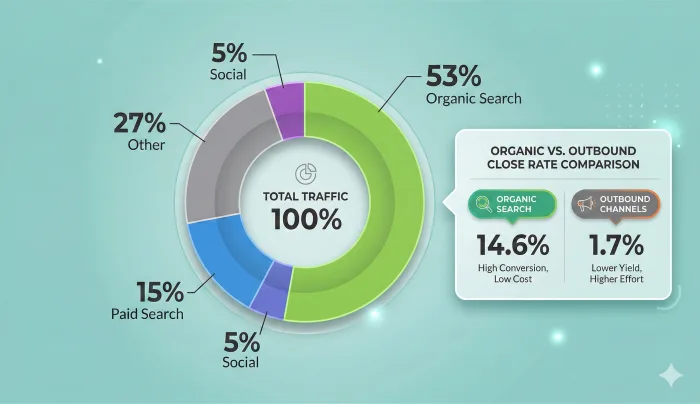
Organic search drives 53% of all website traffic. Paid search drives 15%. But the right answer isn't always SEO — here's how to decide.
Here's the uncomfortable truth about the SEO vs. paid ads debate: anyone who tells you one is always better than the other is trying to sell you something. I've been building digital strategies for over 20 years, and the answer has always been the same — it depends on your business, your budget, and your timeline.
Let me give you the real numbers, the real trade-offs, and a decision framework you can actually use. No fluff. No agenda.
The Numbers That Matter
Organic search drives 53% of all website traffic across industries. Paid search drives about 15%. Social media drives around 5%. The rest is direct, referral, and email. Those numbers alone make a compelling case for SEO — but they don't tell the whole story.
Here's what they miss: SEO leads have a 14.6% close rate. Outbound leads (cold calls, paid ads to cold audiences) have a 1.7% close rate. That's an 8.5x difference. People who find you through organic search are actively looking for what you sell. People who see your ad are being interrupted.
But paid ads have one massive advantage: speed. SEO takes 4-12 months to deliver meaningful results. A Google Ads campaign can send traffic to your site today.
What SEO Actually Costs
SEO isn't free. That's one of the biggest myths in marketing. It costs time, expertise, or money — usually all three.
A realistic SEO investment for an SMB looks like this:
- DIY approach: 10-20 hours/month of your time + tools (€100-300/month for Ahrefs or Semrush)
- Freelancer or consultant: €500-€2,000/month
- Agency: €1,500-€5,000/month
But here's where SEO wins the cost argument: it compounds. A blog post you publish today can drive traffic for years. After 12 months of consistent SEO work, your cost per lead drops dramatically because old content keeps working while you create new content.
Month 1: You spend €1,500 and get 50 visitors from organic search. That's €30/visitor. Month 12: You've spent €18,000 total and you're getting 2,000 visitors/month. That's €9/visitor — and dropping every month. Month 24: €36,000 total spent, 5,000 visitors/month. Cost per visitor: €7.20 and still falling.
This compounding effect is something paid ads can never replicate.
What Paid Ads Actually Cost
The average SMB spends €1,000-€10,000/month on Google Ads. But averages are misleading. What matters is your cost per click (CPC), which varies wildly by industry:
- Travel & hospitality: €1-€3 per click
- E-commerce (general): €1-€5 per click
- Real estate: €2-€8 per click
- B2B services: €5-€15 per click
- Legal services: €10-€50 per click
- Insurance: €15-€50+ per click
Now do the maths. If you're a law firm paying €30/click with a 3% conversion rate, each lead costs you €1,000. If you're a restaurant paying €1.50/click with a 5% conversion rate, each lead costs €30. Same platform, wildly different economics.
The other problem with paid ads: when you stop paying, the traffic stops. Immediately. There's no residual value. Every visitor requires a fresh payment.
When SEO Wins
SEO is the better investment when:
- Your timeline is 6+ months. If you can wait for results, SEO delivers dramatically better ROI over time.
- Your CPC is high. In industries where clicks cost €10+, the maths strongly favour organic traffic.
- Your content can compound. If you can create helpful resources that people search for repeatedly (how-to guides, comparison pages, educational content), SEO pays dividends for years.
- You have expertise to share. Google's E-E-A-T framework rewards genuine expertise. If you know your industry deeply, that knowledge becomes an SEO asset.
- Your competitors are weak at SEO. In many local markets, the SEO competition is surprisingly thin. Five good blog posts might be all it takes to own the first page.
When Paid Ads Win
Paid ads are the better choice when:
- You need results this week. Launching a new product? Running a promotion? Filling seats at an event? You don't have 6 months to wait for SEO.
- You're testing a new market. Before investing in SEO content for a new service, run paid ads to validate demand. If nobody clicks, SEO won't save you either.
- Your industry has low CPCs. If clicks cost €1-€3, paid ads can be extremely cost-effective — especially for e-commerce with clear conversion tracking.
- You have a high customer lifetime value. Spending €200 to acquire a client worth €20,000/year? That's a no-brainer, regardless of channel.
- You need precise targeting. Paid ads let you target by location, demographics, device, time of day, and search intent with precision that organic search can't match.
When You Need Both (Most SMBs)
Here's the strategy that actually works for most businesses with a marketing budget of €2,000-€10,000/month:
Months 1-3: Lead with paid ads, start SEO
- Allocate 70% to paid ads for immediate lead generation
- Use 30% for SEO foundations: technical audit, keyword research, content strategy
- The paid ads fund your business while SEO builds momentum
Months 4-6: Shift the balance
- Move to 50/50 as SEO starts generating organic traffic
- Use paid ad data to inform SEO — which keywords convert tells you what content to create
- Start reducing spend on keywords where you're ranking organically
Months 7-12: SEO takes over
- Shift to 30% paid ads, 70% SEO
- Keep paid ads only for high-intent bottom-of-funnel keywords and retargeting
- Organic traffic should now be generating leads at a fraction of the paid cost
Month 12+: Strategic paid only
- SEO handles 80%+ of your search traffic
- Paid ads reserved for product launches, promotions, and competitive keywords you haven't cracked organically yet
- Total cost per lead is dramatically lower than month 1
The Decision Framework
Ask yourself these five questions:
- How urgently do you need leads? (This week = paid. This quarter = both. This year = SEO.)
- What's your CPC in Google Ads? (Under €3 = paid is viable long-term. Over €10 = SEO is almost certainly better ROI.)
- Can you create expert content? (Yes = SEO has huge upside. No = paid might be your only option.)
- What's your customer lifetime value? (High LTV makes paid ads viable even at high CPCs.)
- How competitive is your local market's SEO? (Low competition = SEO gold. Saturated = supplement with paid.)
If you answered "paid" to three or more, start there. If you answered "SEO" to three or more, invest there. If it's mixed, you need both.
What About AI Search?
There's a new player in this game. AI search engines like Perplexity, ChatGPT search, and Google's AI Overviews are changing the equation. These platforms don't show traditional ads (yet) — they cite organic sources. That means SEO is currently the only way to get visibility in AI search results.
In 2026, ignoring AI visibility means ignoring a growing share of how people find information. Paid ads don't buy you a mention in Claude's recommendations or Perplexity's citations. Only genuine, authoritative content does.
This is the strongest argument for investing in SEO now, even if paid ads are working for you today. The search landscape is fragmenting, and organic authority is the one asset that translates across all platforms.
The Bottom Line
SEO and paid ads aren't competitors — they're different tools for different situations. The businesses that win are the ones that understand when to use each one and aren't ideological about it.
Stop asking "Which is better?" Start asking "Which is better for my specific situation, right now, with my budget and timeline?"
The answer is always more nuanced than a marketing blog wants you to believe. But now you have the framework to figure it out yourself.
Preguntas frecuentes
- Is SEO better than paid ads for small businesses?
- It depends on your timeline and budget. SEO delivers higher long-term ROI — organic search drives 53% of all website traffic — but takes 3-6 months to show results. Paid ads generate immediate visibility but stop the moment you stop paying. Most SMBs benefit from a phased approach combining both.
- How much does SEO cost compared to Google Ads?
- SEO typically costs €500-€3,000 per month for an SMB, with results compounding over time. Google Ads costs vary by industry, with average cost-per-click ranging from €1 to €50+. SEO's cost per acquisition drops over time, while paid ads remain constant.
- When should I use paid ads instead of SEO?
- Use paid ads when you need immediate results, are launching a new product, targeting time-sensitive promotions, or competing in a market where organic rankings are dominated by large brands. Paid ads are also effective for testing which keywords convert before investing in SEO.
Want to discuss this for your business?
Tell us what you need. We'll tell you what's possible.
Start a project