

97% of consumers search online before choosing a local business.
That number comes from BrightLocal's annual survey, and it's been above 90% for five years running. If your business isn't easy to find online, you're invisible to virtually every potential customer in your area. Not some of them. Nearly all of them.
The good news: visibility isn't about budget. It's about doing 5 specific things well. Most of your competitors have done one or two of these, maybe. Almost none have done all five. Here's your checklist.
1. Claim and Complete Your Google Business Profile
This is the single most impactful free action any local business can take. When someone searches "dentist near me" or "Italian restaurant in [your neighbourhood]," Google shows a map pack — three businesses with their name, reviews, photos, and key details. That map pack gets 42% of all clicks on the results page.
Businesses with complete Google Business profiles are 70% more likely to attract location visits and 50% more likely to lead to a purchase, according to Google's own data.
What "complete" means:
- Every category that applies to your business is selected
- Business hours are accurate (including holiday hours)
- Photos are uploaded — at least 10, including your storefront, interior, team, and products/services
- Your business description uses natural language that describes what you actually do
- You've added your services or menu with pricing
- You post updates at least monthly (events, offers, photos)
Do this today: Go to business.google.com. If you haven't claimed your profile, claim it now. If you have, spend 20 minutes filling in every field you've left blank. Upload 5 new photos.
2. Make Your Business Information Consistent Everywhere
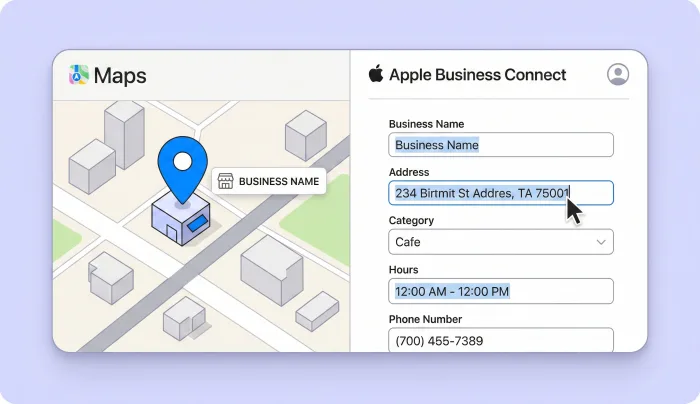
Your business name, address, and phone number (called NAP in marketing speak) need to be exactly identical on every platform where you appear. Not similar. Identical. "123 Main Street" and "123 Main St" are different in the eyes of search engines.
Why this matters: search engines and AI systems cross-reference your information across multiple sources. When your details match everywhere, it builds trust. When they conflict, it creates doubt — and doubt means lower rankings and fewer recommendations.
The platforms that matter most:
- Your website (header, footer, and contact page)
- Google Business Profile
- Bing Places for Business
- Apple Business Connect
- Facebook business page
- Industry-specific directories (Yelp, TripAdvisor, Avvo, Zocdoc — whatever applies to your field)
93% of consumers are frustrated by incorrect information on business listings, and 63% say they'd avoid a business because of it.
Do this today: Search your business name on Google. Open every listing that appears on the first 2 pages. Check that your name, address, phone number, and hours match exactly. Fix any discrepancies.
3. Create Content That Answers Real Questions
You don't need to become a blogger. You need to answer the questions your customers already ask you every day. Think about the last 10 phone calls or emails you received. What were people asking? Those questions are content.
Examples:
- A plumber writes "How much does it cost to fix a leaking tap in [city]?" — answers a question with local relevance and actual pricing.
- A dentist writes "What to expect at your first visit to [practice name]" — reduces anxiety and builds trust before the appointment.
- A restaurant adds a page about "Private dining for groups of 10-20" — captures a specific, high-value search.
This kind of content does double duty. Google rewards pages that directly answer search queries — featured snippets and answer boxes appear in 19% of all search results, and the content that wins those positions is almost always a clear, direct answer to a specific question. AI systems like ChatGPT and Perplexity do the same — they pull from content that directly and clearly answers the question a user asked.
Do this today: Write answers to your 3 most frequently asked customer questions. Publish them on your website as a FAQ page or as individual blog posts. Keep each answer under 500 words. Be specific — include prices, timeframes, and real details.
4. Build a Review Strategy (Not Just a Hope)
Reviews aren't optional anymore. 93% of consumers read online reviews before making a purchase decision. And the impact on search rankings is measurable — Google has confirmed that review quantity, quality, and recency all factor into local search rankings.
The difference between businesses with 15 reviews and businesses with 100+ reviews is enormous — not just in perception, but in actual search visibility. Businesses in the top 3 of Google's local pack have an average of 47 reviews.
But here's what most businesses get wrong: they wait for reviews to happen organically. They don't. You need a system.
A simple review system that works:
1. Identify the moment when a customer is happiest (right after a successful service, delivery, or purchase)
2. At that moment, say: "I'm glad we could help. If you have a minute, a Google review would really help us out."
3. Send them a direct link — Google Business Profile generates a short review URL you can copy and share
4. Follow up with a WhatsApp or email containing the link within 24 hours
5. Respond to every review — positive or negative — within 48 hours. This signals to Google and AI systems that you're engaged and responsive.
One dental practice we worked with went from 12 reviews to 89 reviews in 4 months using this exact process. Their Google Map Pack visibility tripled.
Do this today: Go to your Google Business Profile, find your review link (under "Ask for reviews"), and save it. Send it to your last 5 happy customers.
5. Make Sure AI Assistants Know About You
This is the step most businesses haven't taken yet — which means it's your biggest opportunity.
ChatGPT, Claude, Perplexity, and Gemini are handling millions of searches per day. When someone asks "recommend a good accountant in Barcelona" or "what's the best bakery near Notting Hill," these AI systems synthesise information from across the web. If they can't find clear, consistent, credible information about your business, they recommend someone else.
How to improve your AI visibility:
- Test it right now. Ask ChatGPT, Claude, and Perplexity: "What do you know about [your business name]?" and "Recommend a [your service] in [your city]." You'll immediately see where you stand.
- Add structured data (schema markup) to your website. This is machine-readable information that tells AI systems exactly what your business does, where it's located, and what customers think. At minimum, add `LocalBusiness`, `Organization`, and `FAQ` schema.
- Create an llms.txt file. This is a new standard — a plain text file on your website that tells AI systems who you are and what you do. It's like robots.txt but for AI assistants.
- Get mentioned on multiple independent sources. AI systems build confidence through triangulation. If your business is mentioned on your website, Google Business Profile, 3 directories, and 2 blog posts, the AI has multiple data points to confirm you're real and relevant.
- Keep your content fresh. AI systems favour recent information. A website last updated in 2023 ranks lower than one updated this month.
Do this today: Run the ChatGPT/Perplexity test above. Note what comes up. That's your baseline. Then implement one improvement from the list.
The Compound Effect
None of these steps is a magic bullet on its own. But together, they create a compound effect that builds over time. A complete Google Business Profile with 80+ reviews, consistent information across the web, content that answers real questions, and AI visibility — that combination puts you ahead of 90% of local businesses.
The most important thing is to start. Pick one of these five actions and do it today. Not next week. Not when you have time. Today. The businesses that consistently show up online are the ones that consistently show up in real life.