We Launched Echoflicks 7 Days Ago. AI Already Writes About Us.
How Echoflicks got cited by ChatGPT, Google AI Overview, and traditional search within one week of launch — with no ads, no PR, and no backlinks.
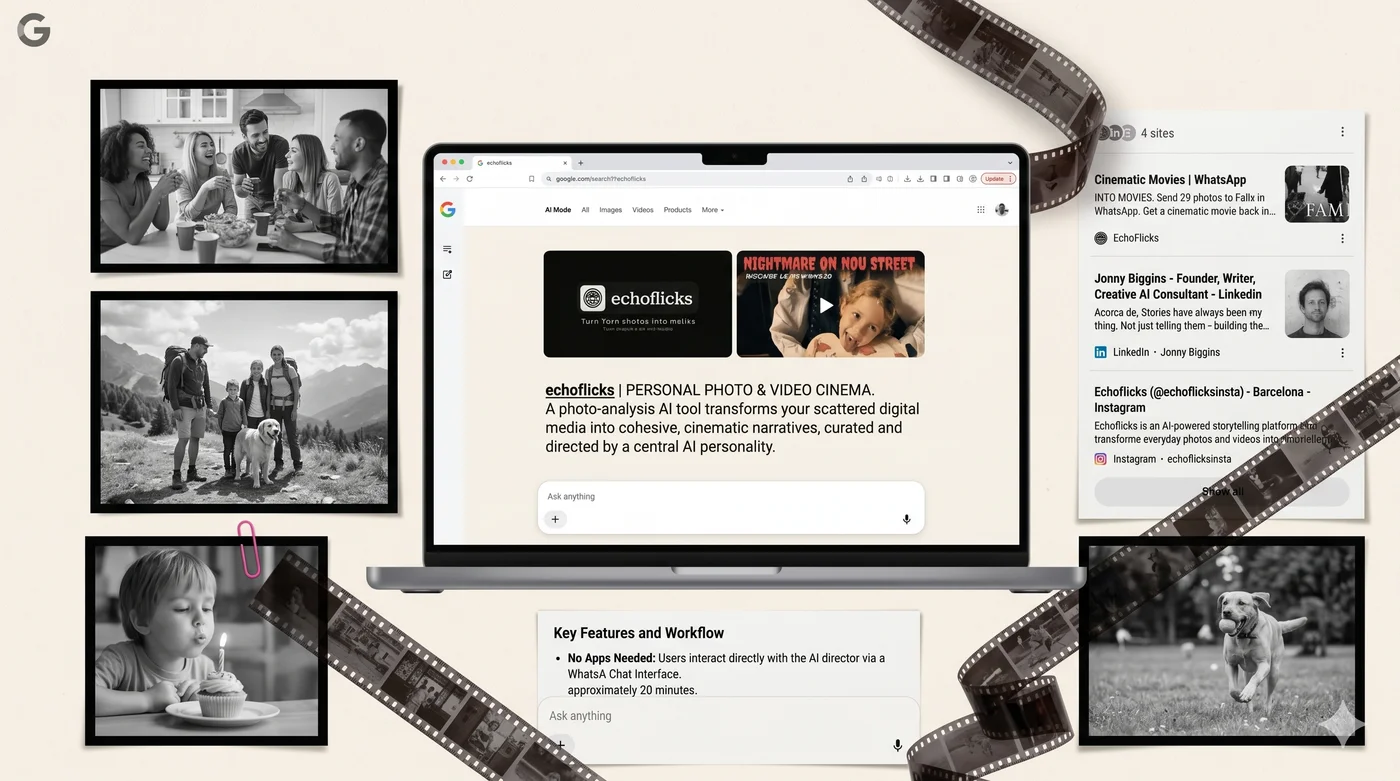
We launched Echoflicks a week ago. No press. No ads. No Product Hunt launch. A landing page and a WhatsApp bot in Barcelona.
This was a team effort from day one. Jason and Jonny, the founders of Echoflicks, brought the product vision and the creative direction. We at KAUFAST handled the technical SEO, schema architecture, performance engineering, and AI search optimisation. Their team built the product. Our team made sure the machines could find it. That collaboration is the reason this story exists.
Then someone asked ChatGPT about us.
It didn't just mention us. It wrote five paragraphs. It described our product, our process, our positioning, even our keyword strategy. It told people what makes us different — that we're not selling AI video creation, we're selling the emotional outcome of turning memories into movies. It listed our competitors. It offered to analyse our revenue model.
We didn't brief it. We didn't submit anything. We didn't pay for AI SEO tools. One week in, and the machine already knows who we are, what we do, and why it matters.
Google's AI Overview does the same thing. Google organic search ranks us first. Seven days from zero to cited — across traditional search, AI Overviews, and conversational AI.
This is the story of how that happened — and what we think it means for anyone launching something new.
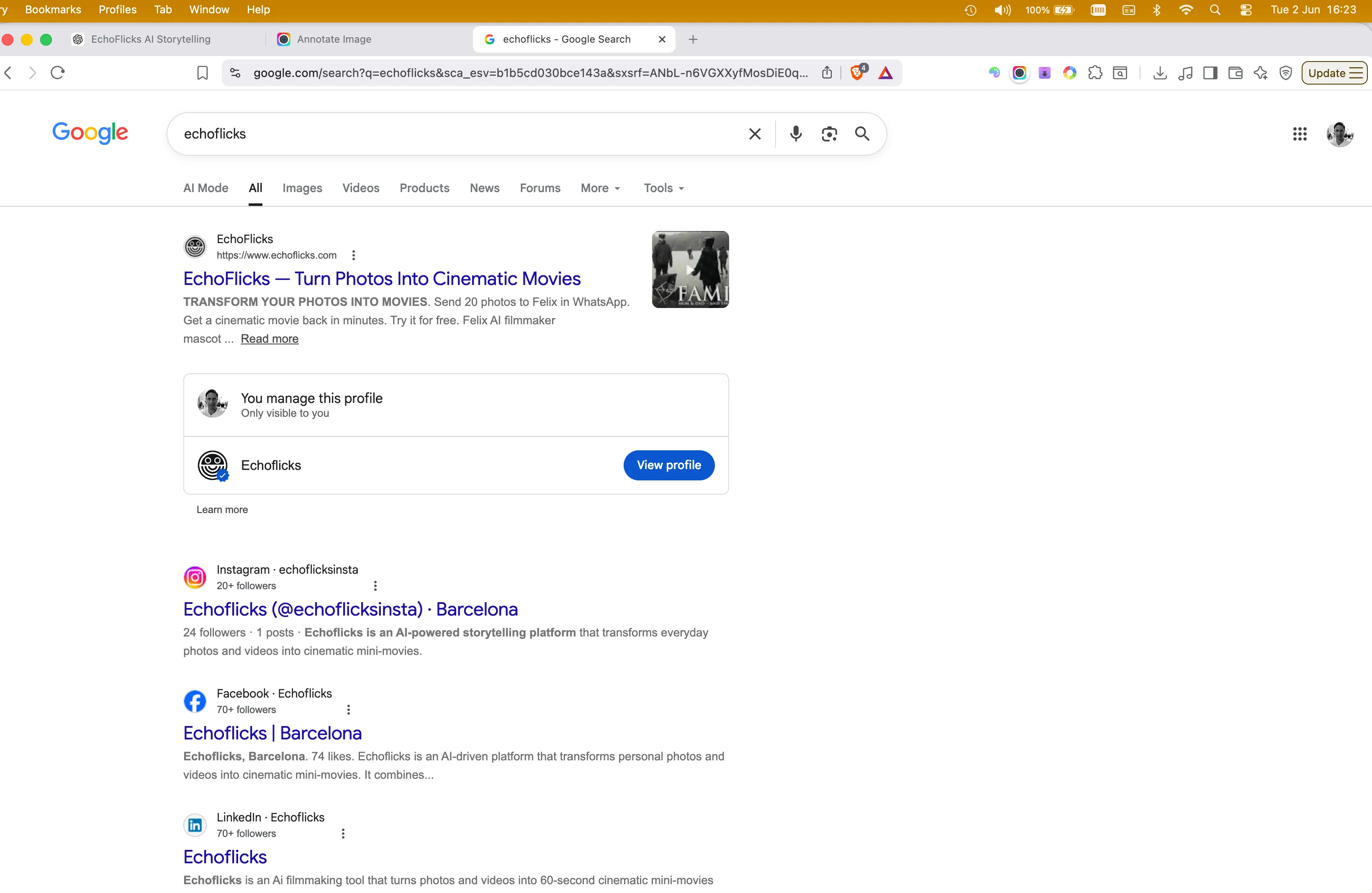 Google Search results for "echoflicks" — June 2, 2026. First position with knowledge panel, Instagram, Facebook, and LinkedIn all indexed.
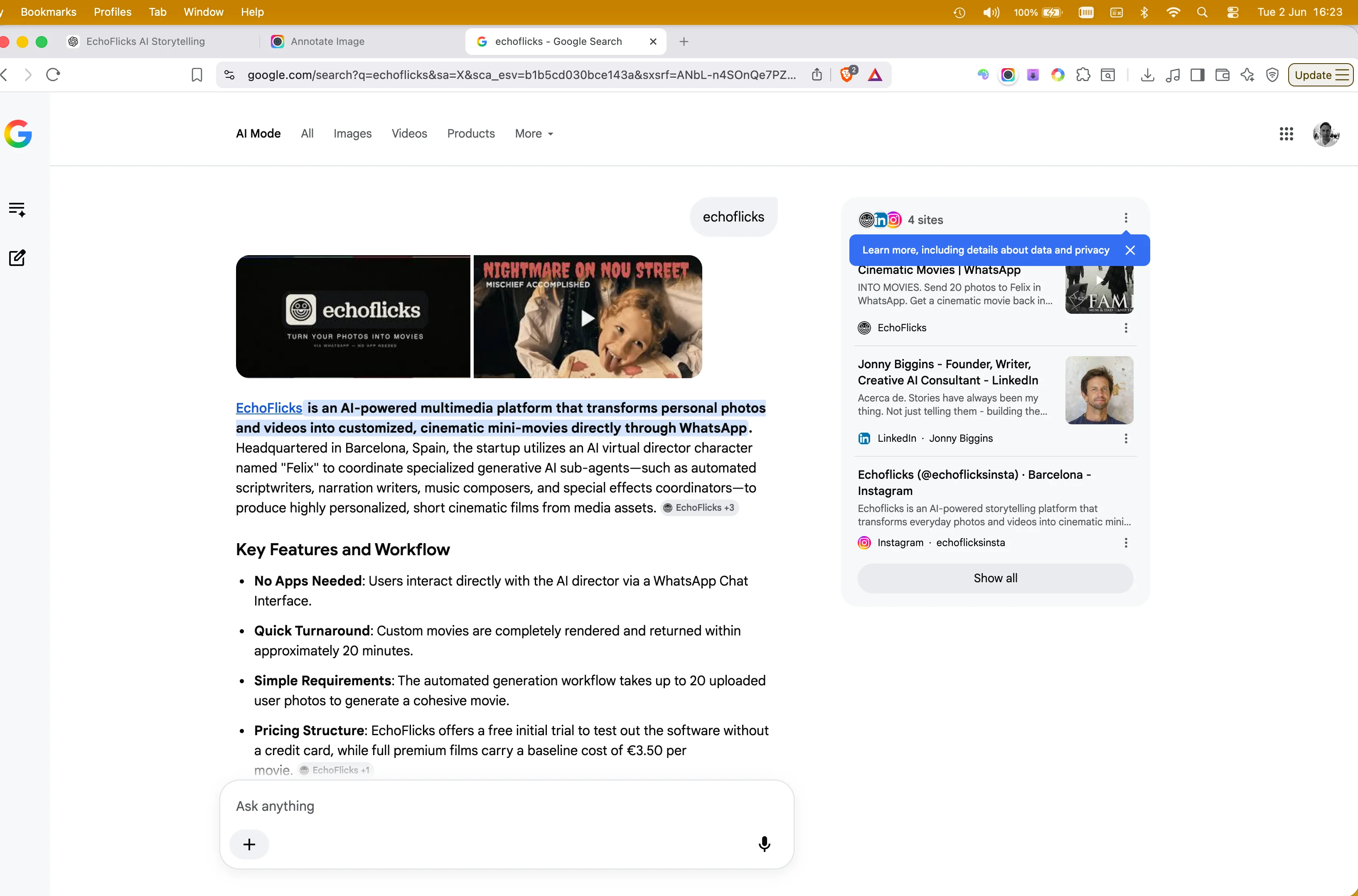 Google AI Overview — June 2, 2026. Full product description generated from our website content, citing 4 sources.
How Sitting Between Categories Gets You Cited by AI
Most startups launch into an existing category and fight for position. AI video editor. Photo slideshow maker. Those searches have thousands of results, millions of ad dollars behind them, and a decade of SEO moats built by incumbents.
We didn't enter any of those categories. Instead, we built a product that sits at the exact intersection of existing semantic clusters.
There is no other product where you message an AI filmmaker on WhatsApp, send him your holiday photos, and get a cinematic movie back in twenty minutes. Nobody else does that. Not Canva. Not CapCut. Not Luma. Not Runway.
When ChatGPT categorised us, it didn't invent a new industry — it mapped us across five existing nodes: AI video generation, consumer photo products, memory preservation, family storytelling, and personalised gifts. We became the missing link between them.
That matters because of how large language models retrieve information. When someone asks "can I turn my photos into a movie on WhatsApp," the model searches its training data and any retrieved sources for the most relevant answer. If there are ten thousand competing pages, you're fighting for a mention. If there's one page that exactly matches the intersection of those concepts — you're the answer.
We didn't optimise for general AI search. We built something specific enough that when someone describes the use-case, they are exclusively describing us. The niche is the strategy.
What ChatGPT Actually Said About Us
This is what ChatGPT returns when someone asks about Echoflicks — one week after launch, no prompting, no paid placement:
"Echoflicks is a Barcelona-based AI storytelling platform that turns your personal photos and videos into short cinematic movies called 'Echoes.' Instead of using a video editor, you send 15–25 photos to an AI filmmaker named Felix through WhatsApp, answer a few questions, and receive a professionally produced mini-movie back in around 20 minutes."
It goes further. It describes the technical specs — script, voiceover, soundtrack, colour grading, titles. It explains the positioning: "Most AI video tools start with text prompts. Echoflicks starts with real memories." It even suggests keywords we should target and offers to analyse our strengths and weaknesses.
Read that again. An AI — without being asked by us, without being fed a press release, without any backlink strategy — wrote a competitive analysis of our business. In week one.
How?
How Plain Language Improves AI Search Visibility
Our website says what we do in one sentence: "Send 20 photos to Felix in WhatsApp. Get a cinematic movie back in minutes."
That's not a tagline we workshopped for six weeks. It's a literal description of the product. And it turns out that's exactly what AI retrieval systems — whether they use RAG pipelines, Google's Search Generative Experience, or direct model knowledge — need to cite you.
AI doesn't reward clever copy. It rewards clarity. When a model is generating a response and looking for a source to reference, it needs content it can extract and paraphrase accurately. Compare these two approaches:
Don't: "Unlock the power of your visual memories with our AI-driven content transformation platform."
Do: "Send your photos to Felix on WhatsApp. He writes a script, scores original music, colour grades your shots, and sends back a 60-second cinematic movie."
The first one is marketing. The second one is information. AI models cite information.
Every section of our site follows this principle. The "How It Works" section is three steps. The FAQ has eight questions with one-sentence answers. We wrote our website like a Wikipedia article that happens to have good design. Declarative. Specific. Quotable.
Why FAQ Sections Are Critical for AI Search Visibility
FAQ is not the only thing that matters — but it's one of the highest-leverage things you can do. A well-structured FAQ section is one of the most effective tools for generative engine optimisation, and here's why.
Large language models are trained on — and actively retrieve — question-answer pairs. That's a format they handle exceptionally well. When someone asks an AI a question, it looks for content that's already structured as a question with a clear answer. Your FAQ doesn't just feed information to the model — it gives the model a pattern it can synthesise from, weigh heavily, and paraphrase with confidence.
Our eight FAQs cover:
- Do I need an app? No, it's WhatsApp
- How long? 20 minutes
- How much? Free, then €9/month
- What kind of films? 60-second cinematic movies with narration and original music
- What about privacy? EU servers, never used for training
- Can I use it as a gift? Yes
- What photos work? Anything from your camera roll, 15–25
- Does it generate fake images? No, only your real photos
Every single one of those showed up — paraphrased, synthesised, or directly referenced — in ChatGPT's description of us. The Q&A structure gave the model high-confidence source material to work with.
But FAQ alone doesn't get you cited. The FAQ worked because it sat on top of a fully optimised technical stack — server-side rendering, JSON-LD schema markup, sub-second load times, and semantic HTML. Each layer reinforces the others. The FAQ gave AI models the content format they prefer. The schema told them what the content means. The performance ensured they could access it instantly.
How Technical SEO Fundamentals Drive AI Indexing Speed
This happened in seven days. Traditional SEO wisdom would tell you to wait three to six months for a new domain to build authority. We didn't wait. We didn't need to.
This is where the behind-the-curtain work matters. The visible content is what AI models cite. But the technical infrastructure is what makes that content discoverable in the first place. Jason and Jonny's team focused on building the product. We focused on making every machine on the internet — crawlers, LLMs, retrieval systems — able to find it, read it, and cite it.
We were rigorous about technical SEO fundamentals — the infrastructure that makes content discoverable by any machine, whether it's a traditional crawler or an LLM retrieval system.
Server-side rendering. When Google's crawler hit our site, it got a complete HTML document on the first request. Not a blank <div id="root"> that waits for JavaScript to hydrate. The crawler reads it, indexes it, and moves on. This matters equally for RAG systems that pull from web indexes — if your content isn't in the HTML, it doesn't exist.
Two real URLs per language. We support English and Spanish. Each language is a real, server-rendered page with its own URL. Google sees two pages, each with its own proper hreflang links pointing to the other. No ambiguity.
Semantic HTML. Proper heading hierarchy. Alt text on every image. The markup reads like a document because it is one. This gives both crawlers and LLMs a clean content tree to parse.
Schema markup and structured data. We implemented JSON-LD schema — Organization, WebSite, and structured product information — so search engines and AI systems don't have to guess what the page is about. Schema markup is the difference between a crawler reading your content and a crawler understanding your content. It tells Google and AI retrieval systems exactly what entities exist on the page, how they relate, and what the page is for.
Performance on GCP. The site is hosted on Google Cloud Platform, optimised for sub-second load times on mobile. 95+ Lighthouse Performance, 100 Accessibility, 100 Best Practices, 100 SEO. Google allocates crawl budget based on speed. Fast sites get indexed faster — and when you're a new domain competing against zero, every hour of indexing speed matters.
Google Search Console from day one. We submitted the sitemap, requested indexing for every URL through the URL Inspection tool, and monitored crawl activity in real time. We didn't wait for Google to discover us. We told Google where to look and verified it was looking.
The full stack matters. None of these things work in isolation. FAQ without schema is less effective. Schema without fast rendering is slower to index. Fast rendering without plain-language content gives AI nothing to cite. The reason Echoflicks got cited in seven days is that every layer of the stack — content, structure, markup, performance, and infrastructure — was built to work together.
The Emotional Outcome Is the Keyword
ChatGPT's analysis of our positioning included something we didn't expect:
"The strongest differentiator is that they are not selling 'AI video creation'; they are selling the emotional outcome: turning memories into movies."
This is the shift that matters. We didn't ignore keyword research; we completely redefined it. We traded high-volume functional keywords ("AI video editor") for high-intent outcome phrasing ("turn photos into cinematic movie").
We don't describe a tool. We describe what happens to you. Your photos become a movie. Your memories come alive. You press play and you feel something.
That emotional framing doesn't just work for humans — it works for AI too. When ChatGPT describes us, it doesn't say "Echoflicks is an AI video editor." It says Echoflicks turns personal photos into cinematic movies. It understood the emotional pitch because the emotional pitch was the only pitch on the page.
If your website describes features, AI will list you alongside every other feature-based competitor. If your website describes outcomes, AI will explain why you're different.
What This Means for Anyone Launching
You don't need a domain authority of 80. You don't need backlinks from TechCrunch. You don't need three months of content marketing before AI notices you.
You need five things working together:
1. Be specific. Do one thing that nobody else does in exactly the way you do it. AI can't cite you if you sound like everyone else.
2. Say it plainly. Write your site like you're explaining your product to a smart friend. No jargon. No abstractions. Declarative sentences that a retrieval system can extract and an LLM can paraphrase with confidence.
3. Structure it for questions. Add an FAQ. Make the answers direct. One question, one answer, no hedging. FAQ sections are one of the highest-leverage things you can do for AI visibility — but they're not the only thing.
4. Build the technical stack. Schema markup, server-side rendering, sub-second load times, semantic HTML, structured data. The behind-the-curtain work is what makes everything else discoverable. Content without infrastructure is invisible.
5. Make it a team effort. This didn't happen because one person did one thing well. Jason and Jonny brought the vision for Echoflicks and knew their product inside out. Their team built the experience. We brought the technical SEO, the schema architecture, the performance engineering, and the AI search strategy. The best results happen when the people who know the product work alongside the people who know the machines. Always.
We launched a landing page in Barcelona seven days ago. We have no PR team, no backlinks, no ad spend. And when you ask the world's most-used AI what Echoflicks is, it writes a better description of our product than we could. When you search Google, we're first. When Google generates an AI Overview, it cites us from four sources.
The machines are listening. Just say something worth repeating — and build the infrastructure so they can hear you.
See the full Echoflicks project on KAUFAST.
Domande frequenti
- What is Generative Engine Optimisation (GEO)?
- GEO is the practice of optimising website content so it gets cited by AI models like ChatGPT, Google AI Overview, and Perplexity. It focuses on plain language, FAQ structures, semantic clarity, and technical infrastructure — making content easy for LLMs to extract, paraphrase, and cite.
- How did Echoflicks get cited by ChatGPT in 7 days?
- The Echoflicks founding team worked with KAUFAST to build a fast, server-rendered website with declarative plain-language descriptions, structured FAQ pairs, JSON-LD schema markup, semantic HTML, proper hreflang tags, and sub-second load times on GCP infrastructure. The product also occupied a unique niche — AI filmmaker via WhatsApp — meaning there was no competing content for models to choose from.
- Do you need backlinks to appear in AI search results?
- No. Echoflicks had zero backlinks when ChatGPT and Google AI Overview began citing it. AI models prioritise content clarity, structural formatting (especially Q&A pairs), and topical uniqueness over traditional authority signals like backlinks.
- What makes a website visible to AI search engines?
- A combination of factors working together: plain-language content AI can extract and paraphrase, FAQ sections structured as Q&A pairs, proper schema markup (JSON-LD), fast server-side rendering, semantic HTML, and a unique niche position. No single factor works alone — it's the full technical and content stack that earns AI citations.
- How fast does Google index a new website in 2026?
- With proper technical SEO — server-side rendering, submitted sitemap, fast load times, and semantic HTML — Google can index a new site within days. Echoflicks was indexed in Google Search and Google AI Overview within 7 days of launch.