

You've done the hard work. You rank on page one. Your traffic is climbing. Your SEO dashboard looks great. But revenue? Flat. Leads? Trickling in. The phone isn't ringing more. What's going on?
Here's the uncomfortable truth: traffic without conversions is just expensive vanity. It looks good in reports. It makes you feel like things are working. But if visitors aren't becoming customers, your SEO is a cost centre, not a revenue driver. The average website converts just 2.35% of visitors. The top 25% of websites convert at 5.31% or higher. That gap — from 2.35% to 5.31% — is the difference between an SEO programme that pays for itself 10x over and one you quietly cancel after a year.
The gap isn't about traffic volume. It's about what happens after the click. And most businesses spend 90% of their budget getting the click and 10% optimising what comes next. That ratio should be reversed.
The Search Intent Mismatch Problem
The #1 reason SEO traffic doesn't convert is a mismatch between what the person searched for and what your page delivers. This mismatch causes 60-70% of immediate bounces from organic search.
Every search query has an intent behind it:
- Informational: "How does solar panel installation work?" — they want to learn
- Commercial: "Best solar panel installers in Barcelona" — they're comparing options
- Transactional: "Solar panel installation quote" — they're ready to buy
If someone searches "solar panel installation quote" and lands on your 2,000-word educational article about how solar panels work, they'll leave. They don't need education. They need a quote form. And if someone searches "how does solar panel installation work" and lands on your pricing page, they'll also leave. They're not ready to buy yet.
Your fix: Audit your top 20 landing pages from organic search. For each one, check what keywords drive traffic to it (in Google Search Console → Performance → Pages → click the page → Queries). Does the page content match the intent of those queries? If not, either restructure the page or create a new page that matches.
Landing Page Optimisation That Actually Moves Numbers
Once intent is matched, the page itself needs to convert. Here's what the data shows:
Above-the-fold clarity. Visitors decide within 5-7 seconds whether to stay or leave. In those seconds, they need to see: what you offer, who it's for, and what to do next. If your above-the-fold area is a stock photo and a vague tagline ("Transforming businesses with innovative solutions"), you've already lost.
Test this: show your landing page to someone who's never seen it for 5 seconds, then hide it. Ask them: what does this company do, and who is it for? If they can't answer, your page fails the clarity test.
One page, one goal. Every landing page should have a single primary call to action. Not three. Not five. One. A service page's goal is a quote request. A blog post's goal is an email signup or a link to the service page. A pricing page's goal is a purchase or trial signup.
Pages with a single CTA convert 266% more than pages with multiple competing CTAs. Kill the clutter.
Trust Signals: The Conversion Multiplier
People don't buy from websites they don't trust. And trust is built through evidence, not claims.
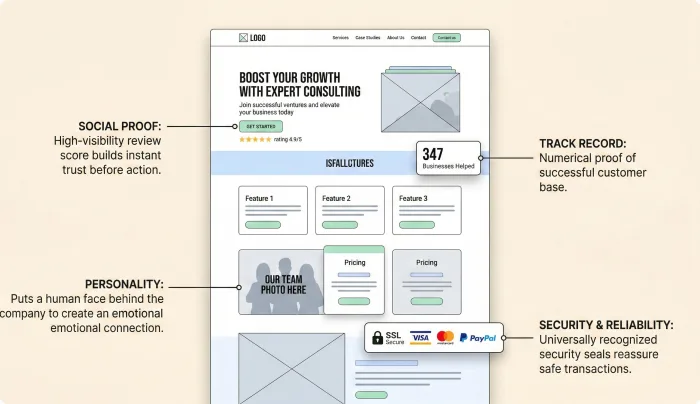
Social proof increases conversions by 15% on average, and it can go much higher depending on implementation. Here's what works:
- Customer reviews and ratings displayed near the CTA. Not buried on a testimonials page — right there, next to the button you want them to click.
- Specific numbers. "We've helped 347 businesses" is more believable than "We've helped hundreds of businesses." Precision implies honesty.
- Named case studies with measurable results. "We helped ABC Restaurant increase online orders by 45% in 3 months" is worth more than 10 generic testimonials.
- Trust badges. SSL certificate, payment processor logos, industry certifications, association memberships. These reduce anxiety at the moment of purchase.
- Real team photos. Stock photos of handshake-models destroy trust. Real photos of your actual team build it.
An e-commerce study found that adding customer reviews near the purchase button increased conversions by 270% for higher-priced products. The higher the price or commitment, the more trust signals you need.
CTA Placement and Design
Your call to action isn't a decoration. It's the mechanism that turns a visitor into a lead or customer. Here's what the data shows about CTA performance:
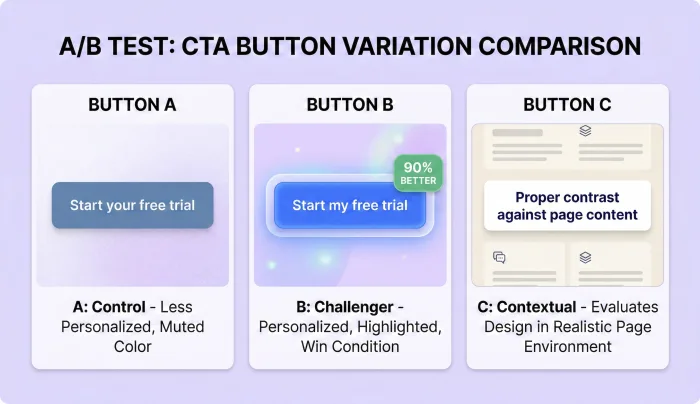
- Colour contrast matters more than colour choice. Your CTA button should be the most visually distinct element on the page. It doesn't need to be red or green — it needs to stand out from everything else.
- First-person language outperforms second-person. "Start my free trial" converts 90% better than "Start your free trial." Small change. Big impact.
- Place CTAs where intent peaks. After you've explained the benefit (not before). After a testimonial (social proof primes action). At the end of a comparison section. And always above the fold.
- Repeat the CTA. On a long page, place it 3-4 times: above the fold, mid-page, after social proof, and at the end. Not identical each time — vary the supporting text.
- Reduce friction in the form. Every additional form field reduces conversions by roughly 11%. Ask for the minimum you need: name, email, and maybe one qualifying question. Everything else can come later.
Page Speed and Conversion
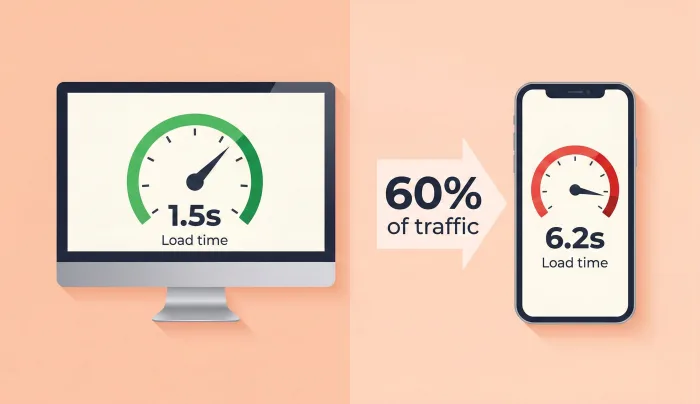
Speed isn't just an SEO factor — it directly impacts conversion rates. Every additional second of load time reduces conversions by 7%. A site loading in 5 seconds has roughly 21% fewer conversions than the same site loading in 2 seconds.
Google found that as page load time increases from 1 to 10 seconds, the probability of a mobile user bouncing increases by 123%. These users never even see your CTA.
If your conversion rate is below average, check your speed before you redesign your page. The cheapest conversion improvement is often just making the page faster.
The Conversion Audit Checklist
Run this audit on every key landing page. Score each item yes/no:
Intent Match:
- Does the page content match the search intent of the keywords driving traffic to it?
- Is the headline aligned with what the visitor expected to find?
- Does the page answer the visitor's primary question within the first scroll?
Clarity:
- Can a stranger identify what you offer within 5 seconds?
- Is there a single, clear primary CTA?
- Is the value proposition specific (numbers, outcomes) rather than vague?
Trust:
- Are there customer reviews visible near the CTA?
- Do you show specific results ("45% increase" not "great results")?
- Are there real team/office photos (not stock)?
- Do you display relevant trust badges or certifications?
Technical:
- Does the page load in under 3 seconds on mobile?
- Does the form have 4 or fewer fields?
- Does the page work properly on all devices?
- Is the CTA button visible without scrolling?
If you answered "no" to more than 3 items, you've found your conversion problem. Fix the "no" items in order from top to bottom — intent mismatch first, because nothing else matters if you're attracting the wrong visitors.
Tracking Conversions Properly
You can't improve what you don't measure. And most businesses measure conversions incorrectly — or not at all.
Set up conversion tracking in GA4. Define what a "conversion" means for your business: form submission, phone call, purchase, booking. Configure these as conversion events in Google Analytics 4. Without this, you're guessing.
Track micro-conversions too. Not everyone converts on the first visit. Track intermediate actions: PDF downloads, email signups, video plays, pricing page views. These tell you whether people are engaging even if they haven't bought yet.
Calculate your cost per conversion. Total SEO investment (agency fees, content costs, tools) divided by organic conversions per month. If you're spending €2,000/month on SEO and getting 20 conversions, your cost per organic conversion is €100. Is that profitable? Depends on your customer lifetime value.
The Bottom Line
SEO traffic is not the goal. Revenue is the goal. Traffic is just the means. The businesses that win at SEO aren't the ones with the most traffic — they're the ones that convert the highest percentage of their traffic into customers.
Before you invest another euro in getting more visitors, make sure the visitors you already have are being converted effectively. Doubling your conversion rate has the same revenue impact as doubling your traffic — but it's typically faster, cheaper, and more sustainable.
We help businesses diagnose why their SEO traffic isn't converting and implement fixes that move the numbers. Not redesigns for the sake of aesthetics — targeted changes based on data, intent analysis, and conversion science.