From SEO to SEO + GEO: Why Ranking on Google Is No Longer Enough
68% of Google searches end without a click. 900M people use ChatGPT weekly. Here's the 5-pillar framework for visibility everywhere.
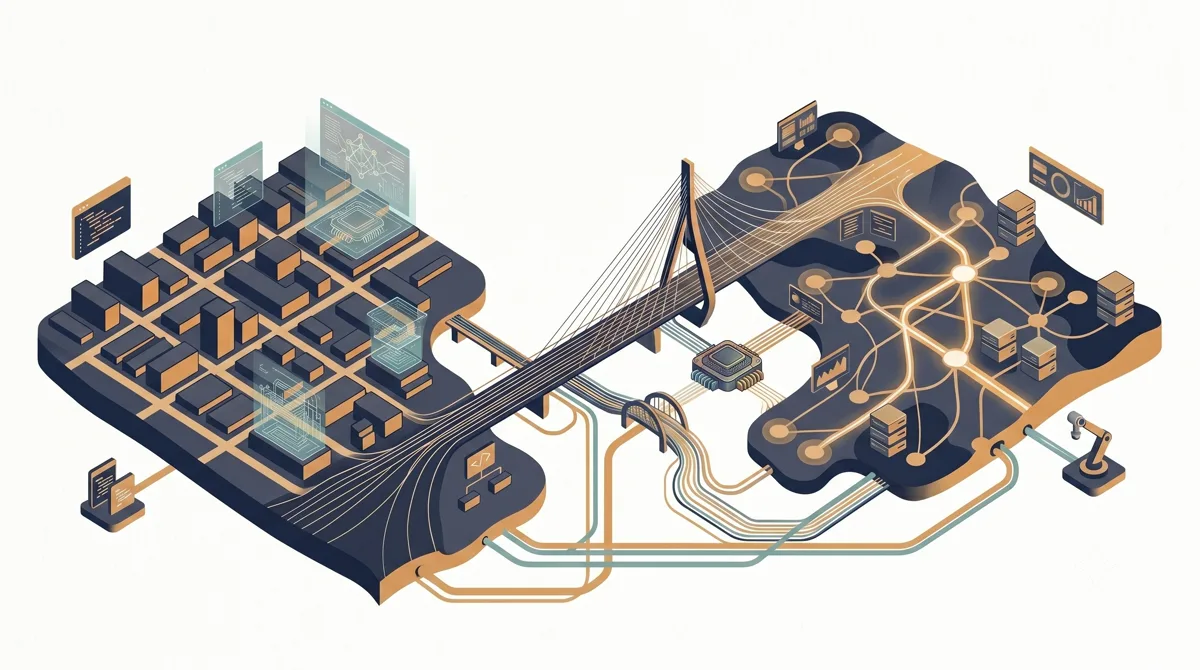
68% of Google searches in the United States now end without a single click to the open web. Learn more about check your AI visibility. On mobile, that number is 77% (SparkToro/Datos, 2024-2025 data). Meanwhile, ChatGPT has cleared 900 million weekly active users, and Google AI Overviews populate on nearly half of all informational queries.
If your entire digital strategy is still built around ranking on page one of Google, you are optimising for a shrinking slice of how people actually find businesses.
The operational divide is clear: leading brands no longer treat traditional organic rankings and generative optimisation as separate conversations.
The Shift to AI Discovery: How ChatGPT and AI Overviews Fragmented the Funnel
Google processes 8.5 billion searches per day and holds roughly 90% of global search market share (StatCounter). Learn more about optimise for alternative search engines. Traditional SEO — keywords, backlinks, technical foundations — still works. Google is not going anywhere.
But the discovery layer has fractured. Learn more about how AI changes discovery. AI is no longer experimental — it is a parallel channel routing buyer intent away from traditional search results.
- Google AI Overviews now appear on an estimated 25-50% of informational queries, providing inline answers before users ever see the blue links (Semrush, BrightEdge studies).
- ChatGPT is used by 900 million people every week (OpenAI, 2026). Many of them are searching for products, services, and recommendations.
- Perplexity, Gemini, and Claude are growing rapidly, each with their own crawling and citation logic.
- 40% of Gen Z starts their search journey on TikTok or an AI chatbot, bypassing Google entirely (Google internal data).
The question in 2025 was: "How do I rank higher in Google?"
The question in 2026 is: "How do I become the answer that Google and AI recommend?"
That is the shift from SEO to SEO + GEO.
The Risk of AI Erasure: Why Page-One Rankings Miss AI Recommendations
Here is a scenario playing out right now across every industry.
Your website ranks #1 organically for a high-intent commercial keyword. Your Google Search Console data looks excellent. Traffic is steady. You feel safe.
But when a prospective buyer asks ChatGPT "What are the best [your service] providers in [your city]?", your brand does not appear. Three of your competitors do. The buyer shortlists them, contacts them, and signs a contract — all without ever seeing your website.
You were not outranked. You were erased.
This is AI Erasure: the state where your traditional search presence is healthy, but your brand is completely invisible to AI-powered discovery channels. It is the biggest hidden threat in digital marketing today because most businesses do not know it is happening. Their dashboards look fine. Their traffic is stable. But an entire layer of buyer intent is being routed around them.
AI-generated answers do not always cite the page that ranks #1 organically. Research from Authoritas and other SEO labs has shown that AI platforms pull from sources based on entity authority, structured data, and cross-platform brand signals — not just SERP position.
If you have not checked whether AI recommends you, here is how to test it right now.
SEO 2025 vs SEO + GEO 2026
| SEO 2025 | SEO + GEO 2026 | |
|---|---|---|
| Primary target | Inverted search engine indexes (Googlebot) | Search indexes + vector embeddings & knowledge graphs |
| Core input | Keywords & search intent | Entity relations, topics & natural language prompts |
| Success metric | SERP rankings & organic traffic | Rankings + AI citation share of voice (SOV) |
| Authority signal | Backlinks & anchor text | Backlinks + cross-platform brand mentions & trusted context |
| Content format | Monolithic pages optimised for keyword density and clicks | Block-structured, declarative passages optimised for vector extraction |
| User destination | Direct website clicks | Walled-garden AI answers + deep referral links |
| Goal | Get clicks | Get discovered, cited, trusted & chosen |
The critical insight: everything from 2025 still matters. GEO is not a replacement for SEO. It is an additional layer built on top of strong SEO foundations. You cannot skip straight to AI visibility without first having your technical SEO, content authority, and brand signals in order.
The KAUFAST 5-Pillar Visibility Framework
We deploy this framework with every client because it mirrors how both search engines and AI systems actually evaluate authority. Each pillar builds on the one below it.
Pillar 1: Technical Foundation
Your website must be perfectly crawlable by search engines and readable by AI systems.
- Indexing & crawlability — clean sitemaps, fast load times, mobile-first rendering, no orphaned pages
- JSON-LD structured data — Organisation, Product, FAQPage, and SameAs schema that explicitly tells machines who you are and what you do
- LLM crawl governance — a well-structured
/llms.txtfile that guides AI crawlers (GPTBot, PerplexityBot, ClaudeBot) to your authoritative content - Security & Core Web Vitals — HTTPS, fast LCP, low CLS, responsive interaction
If AI cannot read your site, AI cannot recommend you. If Google cannot crawl your site, none of the other pillars matter.
For a deeper look at technical foundations, see our guide to why site speed directly affects SEO and revenue.
Pillar 2: Content & Topical Authority
Search algorithms — both traditional and AI — have moved beyond individual keywords. They map concepts.
- Topic clusters — build comprehensive content hubs that completely cover a subject, not isolated blog posts chasing random search volumes
- E-E-A-T signals — first-party data, original case studies, verified author profiles, cited sources. AI engines actively look for unique insights that a base model cannot generate on its own
- Internal linking architecture — structured pathways that connect related content, reinforcing topical authority for both Google and AI crawlers
- Answer-first formatting — lead with clear, definitive statements. Structure content in self-contained blocks of 200-400 words that AI systems can extract as standalone citations
If you want to understand how this plays out in practice, read how Google actually discovers and evaluates your content.
Pillar 3: Brand & Entity Authority
AI engines do not evaluate your website in isolation. They cross-reference what the rest of the web says about you.
- Knowledge Graph presence — consistent entity data across Wikidata, industry registries, Google Business Profile, and high-authority directories
- Brand mentions on trusted platforms — LinkedIn is the #2 most-cited domain by AI search platforms, trailing only YouTube. Being mentioned on platforms AI trusts directly feeds your citation likelihood. See how LinkedIn content drives AI visibility.
- Digital PR & earned media — industry publications, podcast appearances, expert commentary. These are the signals that build the kind of authority AI engines rely on when choosing who to recommend.
- Consistent NAP data — Name, Address, Phone identical everywhere. Inconsistencies confuse both Google and AI knowledge graphs.
Pillar 4: Generative Engine Optimisation (GEO)
This is the new layer. To get cited by an AI search engine, your content must be structured for how AI retrieval systems actually work.
- Passage-level optimisation — AI pulls specific passages, not entire pages. Every major section should be independently citable: a clear claim, supporting evidence, and a concrete recommendation
- Declarative language — lead paragraphs with authoritative assertions. "The average cost of a data breach in 2025 was $4.88 million (IBM)" is citable. "Data breaches can be expensive" is not.
- Multi-format content — text, video, images, structured data tables. AI systems synthesise across formats, and brands producing multiple content types earn broader citation coverage
- Cross-platform validation — your claims should be verifiable from multiple independent sources. AI systems have built-in fact-checking heuristics and preferentially cite sources whose claims appear corroborated elsewhere
For a complete breakdown of how to optimise for Bing (which powers ChatGPT Search), DuckDuckGo, Perplexity, and Claude, see our multi-engine optimisation guide.
Pillar 5: Conversion & Attribution
Visibility is meaningless if you cannot tie it to revenue.
- Intent-aligned landing pages — users arriving from AI citations have already had their needs vetted by an AI assistant. They convert at higher rates than standard organic traffic. Your pages need to match that intent, not repeat the research they have already done.
- Zero-click attribution — stop measuring success by raw session volume alone. Track brand query lift, direct referral flows from AI engines, and revenue attribution that captures the value of AI-driven discovery.
- CRO fundamentals — above-the-fold clarity, fast load times, clear calls to action. Conversion strategies that actually move the needle.
The Visibility Maturity Model: Where Do You Stand?
Most businesses are stuck at Stage 1-2 and do not realise they are exposed. Here is the progression:
Stage 1 — Technical Baseline Your site is indexed, mobile-responsive, and ranks for a handful of branded terms. But you are completely invisible to AI crawlers. This is where roughly 60% of mid-market businesses remain.
Stage 2 — Content Authority You produce solid content that ranks for competitive keywords. But it is not structured for AI extraction, and your entity data is inconsistent across the web.
Stage 3 — Entity Authority Your brand is mapped in Knowledge Graphs with verified cross-references. You appear in AI-generated answers occasionally, but not consistently or across all platforms.
Stage 4 — AI Recommended Your content is systematically cited across Google AI Overviews, ChatGPT, Perplexity, and Gemini. You have a measurable share of voice in AI-generated answers for your core topics. Your competitors are playing catch-up.
We proved this progression works with Echoflicks — an AI-native project that achieved ChatGPT, Perplexity, and Gemini citations within 7 days using this framework. See the full case study.
What to Do Next
The gap between businesses executing this framework and those still running a 2024 SEO playbook is widening every month. Here is where to start:
- Test your AI visibility right now. Open ChatGPT, Perplexity, and Gemini. Ask: "Who are the best [your service] providers in [your city]?" If you do not appear, that is your baseline.
- Audit your structured data. Check whether your site has Organisation, FAQPage, and Product schema in JSON-LD format. If it does not, AI systems are guessing who you are.
- Check your entity consistency. Is your brand name, address, and description identical across Google Business Profile, LinkedIn, your website footer, and industry directories?
- Review your content structure. Can an AI system extract a clear, self-contained answer from each major section of your key pages? Or is your content buried in narrative that requires context to understand?
- Read the full hybrid visibility guide for tactical implementation steps.
The question is not whether AI search matters. It already does. The question is whether your business will be the one AI recommends — or the one it skips.
We help businesses implement this framework through our AI search optimisation service — covering entity strategy, schema architecture, passage-level optimisation, and cross-platform citation tracking.
Frequently Asked Questions
- What is the difference between SEO and GEO?
- SEO (Search Engine Optimisation) focuses on ranking in Google and other search engines through keywords, backlinks, and technical foundations. GEO (Generative Engine Optimisation) focuses on being cited and recommended by AI tools like ChatGPT, Perplexity, and Google AI Overviews. In 2026, you need both working together.
- Is SEO dead in 2026?
- No. Google still holds roughly 90% of global search market share and processes over 8.5 billion searches daily. But SEO alone is no longer sufficient. Over 900 million people now use ChatGPT weekly, and AI Overviews appear on nearly half of informational queries. The businesses winning are combining SEO with GEO.
- What is AI Erasure and how does it affect businesses?
- AI Erasure happens when your website ranks well on Google but is completely absent from AI-generated answers. If ChatGPT, Perplexity, or Google AI Overviews recommend your competitors without mentioning you, buyers never see your brand — even though you technically rank. It is the biggest hidden threat in digital marketing today.
- How do I get my business recommended by AI?
- Build entity authority through consistent structured data (Schema.org JSON-LD), earn brand mentions on trusted platforms, create expert content with cited statistics and E-E-A-T signals, implement an llms.txt file for AI crawlers, and structure your content in clear, self-contained blocks that AI systems can extract and cite.
Want to discuss this for your business?
Tell us what you need. We'll tell you what's possible.
Start a project