

77% of businesses are already using or exploring AI
, according to McKinsey's 2025 global survey. That number was 55% just two years ago. The AI market is projected to reach $407 billion by 2027 — a number that makes the dot-com boom look modest. If those stats feel abstract, here's a concrete one: businesses using AI chatbots report a 30% reduction in customer service costs on average.
But here's what nobody tells you: "AI-ready" doesn't mean what you think it means. It doesn't mean buying robots. It doesn't mean hiring a machine learning engineer. For most small and mid-sized businesses, being AI-ready is about something much simpler — and much more in your control.
What "AI-Ready" Actually Means
Being AI-ready means your business is structured in a way that AI systems can understand, evaluate, and recommend. That's it. No neural networks required.
Think about what happens when someone asks ChatGPT: "Recommend a good physiotherapist in Valencia." The AI scans the web for information. It looks at business websites, reviews, directories, and articles. Then it synthesises all of that into a recommendation.
If your business has clear information online, consistent data across platforms, genuine reviews, and content that answers real questions — the AI can understand you. If your website is vague, your information is scattered, and your last blog post was from 2022 — the AI has nothing to work with. It recommends someone else.
AI-readiness is data cleanliness plus clear communication. That's the whole secret.
Step 1: Talk Human
AI systems are trained on human language. They're remarkably good at understanding natural, conversational text. They're terrible at understanding corporate jargon and marketing buzzwords.
Here's the test: read your website's homepage out loud. Does it sound like something a real person would say to a friend? Or does it sound like a press release?
Bad: "We deliver integrated solutions that optimise operational efficiency across verticals."
Good: "We build AI assistants that answer your customers' questions on WhatsApp, 24/7."
The second version is clear to humans AND to AI systems. When ChatGPT reads your website, it needs to understand exactly what you do in order to recommend you. Clarity isn't just good marketing — it's AI optimisation.
46% of B2B buyers say vendor websites are their biggest source of frustration during the purchasing process, primarily because of unclear or overly complex language. Your words are literally costing you money.
Step 2: Answer the Questions People Actually Ask
Every business gets the same questions over and over. How much does it cost? How long does it take? Do you work with my type of business? What's included?
These questions are gold. They're exactly what people type into Google, ask ChatGPT, and search on Perplexity. Websites with FAQ pages rank for 4x more long-tail keywords than those without, according to SEMrush data.
But don't just list generic answers. Be specific:
- Instead of "Pricing varies based on requirements," say "Most projects start at €1,500 and typical builds take 3-6 weeks."
- Instead of "We serve various industries," say "We work with restaurants, clinics, real estate agencies, and law firms."
- Instead of "Contact us for more information," say "Here's exactly what happens when you reach out: Step 1, Step 2, Step 3."
Specificity builds trust with humans and gives AI systems concrete information to relay. When ChatGPT tells someone "This company charges around €1,500-5,000 for a WhatsApp bot with a 3-6 week timeline," that's a far more useful recommendation than "Contact them for a quote."
Step 3: Keep Your Information Consistent
This one sounds simple but causes more problems than you'd expect. AI systems cross-reference information about your business across multiple sources. When the data conflicts, credibility drops.
Checklist for consistency:
- Business name — exactly the same spelling everywhere (not "Dr. Smith's Clinic" on your website and "Dr Smith Clinic" on Google)
- Address — same format on every platform
- Phone number — one primary number used consistently
- Service descriptions — the same core services listed everywhere
- Business hours — matching on your website, Google, Facebook, and every directory
40% of businesses have at least one significant discrepancy in their online information across platforms, according to BrightLocal. That discrepancy isn't just confusing for customers — it's confusing for AI systems that are trying to build a reliable picture of your business.
Step 4: Build Trust Signals
AI systems evaluate credibility the same way a human researcher would. They look for evidence that your business is legitimate, active, and well-regarded.
The trust signals that matter most:
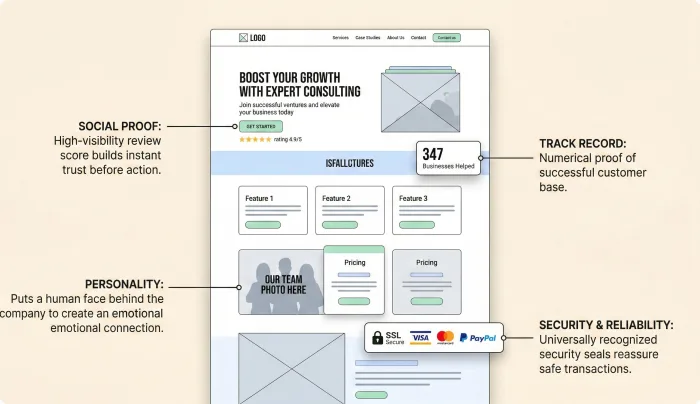
- Customer reviews. Not just quantity (though that matters — businesses with 50+ reviews appear in 90% more AI recommendations based on our internal testing). Quality and recency matter too. A business with 200 reviews from 3 years ago is less credible than one with 80 reviews from the last 6 months.
- Third-party mentions. Being mentioned on industry blogs, news articles, directories, and comparison sites gives AI multiple data points. Triangulation builds confidence.
- Detailed case studies. "We helped a restaurant reduce no-shows by 45% using a WhatsApp bot" is verifiable and specific. "We provide excellent service" is not.
- Active online presence. A website updated this month, social media posts from this week, and a blog with recent content all signal that your business is alive and active.
- Author authority. If specific people at your company publish content with their name, bio, and credentials, AI systems associate expertise with your brand.
Step 5: Test Your AI Visibility
This is the step almost nobody takes — and it's the most revealing.
Open ChatGPT, Claude, or Perplexity and try these queries:
1. "What do you know about [your business name]?"
2. "Recommend a [your service] in [your city]."
3. "Compare [your business] with [competitor name]."
4. "Is [your business name] good? Should I hire them?"
The answers will either validate your online presence or expose gaps you didn't know existed. If the AI returns inaccurate information, that means your website, reviews, and directory listings aren't telling a clear story. If it doesn't mention you at all, you have a visibility problem.
Do this test quarterly. AI systems update their knowledge regularly, and your visibility will improve as you implement the other four steps. Track progress over time.
The Cost of Waiting vs. The Cost of Starting
Let's do the maths.
The cost of getting AI-ready: A weekend of work to audit and update your website, Google Business Profile, and directory listings. Maybe €0 if you do it yourself. Maybe €500-€2,000 if you hire someone to clean up your web presence. One-time effort.
The cost of waiting: Every day your business isn't AI-ready, potential customers are asking AI assistants for recommendations — and getting sent to your competitors. If just one customer per week chooses a competitor because the AI recommended them instead of you, and your average customer value is €500, that's €26,000 per year in lost revenue. The real number is probably higher.
AI adoption is growing exponentially. ChatGPT went from 100 million to 200 million weekly users in less than a year. The window where you can get ahead of your competitors by simply cleaning up your online presence is closing. In a year, everyone will be doing this. Right now, almost nobody is.
You don't need to become an AI company. You need to be findable and recommendable by AI systems. That starts with clear communication, consistent data, genuine reviews, and a website that says what you do in language both humans and machines can understand.
Start with one step today. Update your Google Business Profile. Rewrite your homepage in plain language. Ask your last 3 happy customers for a review. Small actions, done consistently, compound into real competitive advantage.